Force development
Capability-based planning with a source under every line.
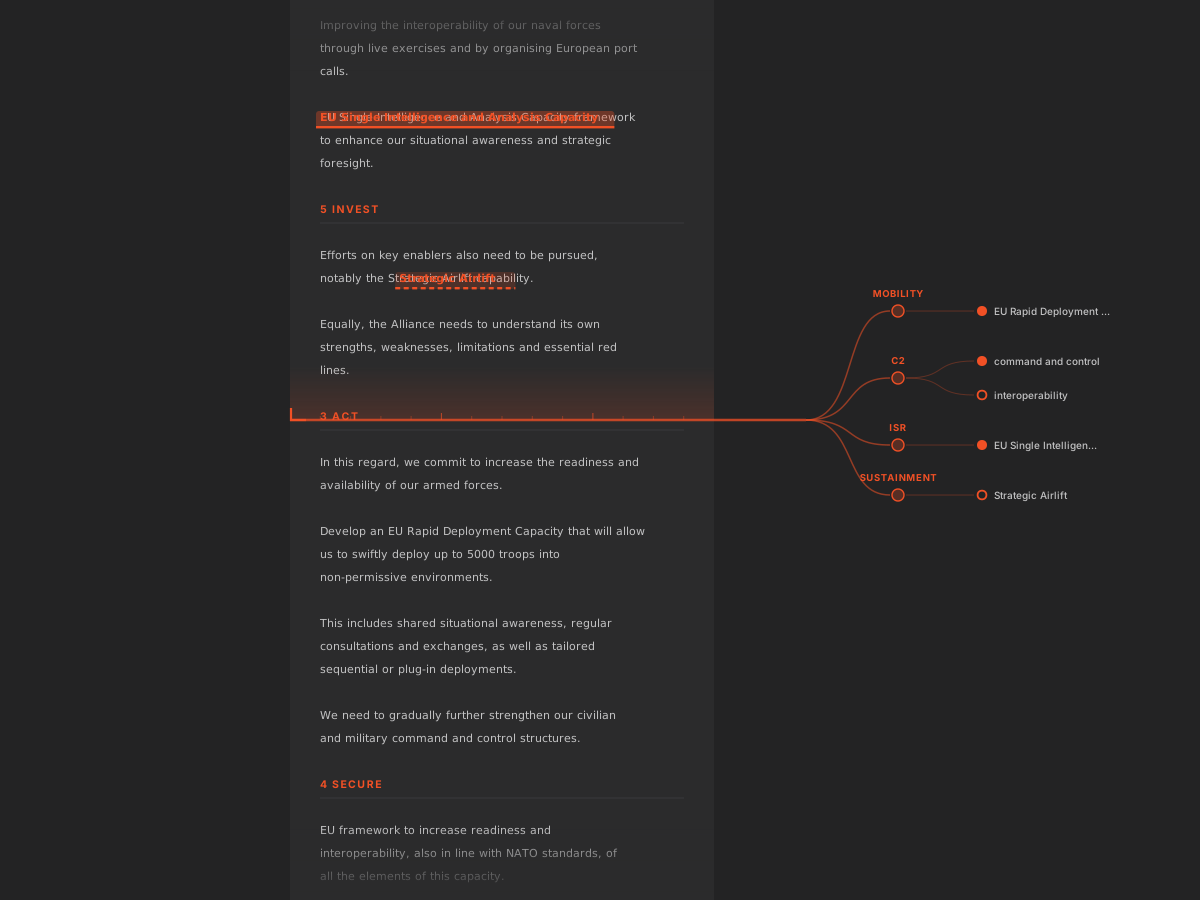
A submission is only as strong as what stands behind each line. FORCE reads the doctrine, concepts and requirement papers your branch already holds, places every passage under one of six combat functions, and names the character range each entry came from.
Six combat functions
Five working days
Every entry names its source passage
In one sentence
For a force development branch that has to evidence every line of a submission, FORCE returns a capability map across six combat functions in which every entry carries the passage it was read from — and gives no recommendation for action.
The situation
Why does an approval board send a submission back?
A submission comes back from an approval board when a requirement statement is asserted and nothing in the file evidences it. The submission is re-staffed, the board date is missed, and the same question returns at the next clearance round.
Capability-based planning starts from documents that already exist: capstone doctrine, service concepts, national strategies, successive editions of lessons learned. Thousands of defence documents are published every year, and the set the branch has to read grows with them. Read one at a time they are clear; read as a set they are hard to compare, because nobody applied the same frame twice.
Silence is harder to see than volume. A dependency that was never written down does not announce itself, so a whole combat function goes unaddressed until an exercise or an operation exposes it.
A requirement statement asserted, with nothing in the file that evidences it
What it costs: The submission is re-staffed and the board date is missed.
A question about the basis for a requirement, with no answer in the room
What it costs: The answer goes back in writing, and the same question returns at the next submission.
An audit office finding that need determination was insufficiently documented
What it costs: A named finding in a published report, and neighbouring programmes pulled into the same review.
The alternatives
What are the five routes to a documented planning basis?
A force development branch is committed to its current tasking, and the set still has to be read before the next submission. Five routes are open, and four of them cost less to start than FORCE. What separates them is elapsed time, whose reading of the set it is, and whether a finding can be traced to a passage afterwards.
| Route | What it gives you | Where it stops |
|---|---|---|
| Do nothing | No release, no contract and no cost. The set stays inside the network and every judgement stays with the branch. | The decision is taken anyway, on a basis nobody has read in full, and what the set was silent on surfaces when it is expensive to correct. |
| Read the set in-house | Nothing leaves the network, and it is the only route open to a set that cannot be released at all. | The reading happens beside the current tasking, so it is slow and rarely finished. The frame changes between readers, and each reader carries the view of the branch they sit in. |
| Commission a consultancy or think tank | A course of action argued by named people who can sit in the room and defend it. | It costs more and takes longer than the window before a board allows, and where a conclusion came from is a question for its author. |
| Run the same PDFs through a model | An answer in minutes, at low cost, inside a network the released set could never leave. | A silence gets filled with a plausible paragraph, no passage ships with the finding it produced, the standpoint the set was read from is not fixed, and a set pasted into a public service has left the branch. |
| FORCE | A capability map across six combat functions in five working days, every entry shipping the passage it was read from and the standpoint it was labelled from. | No entry carries a course of action. A set that cannot be released is not a FORCE engagement, and no price is published here. |
What you get
What does capability-based planning establish about a released set?
A capability map places every relevant passage under one of six combat functions and holds each capability apart from the enablers it depends on. The published worked example ranks 52 topics that way.
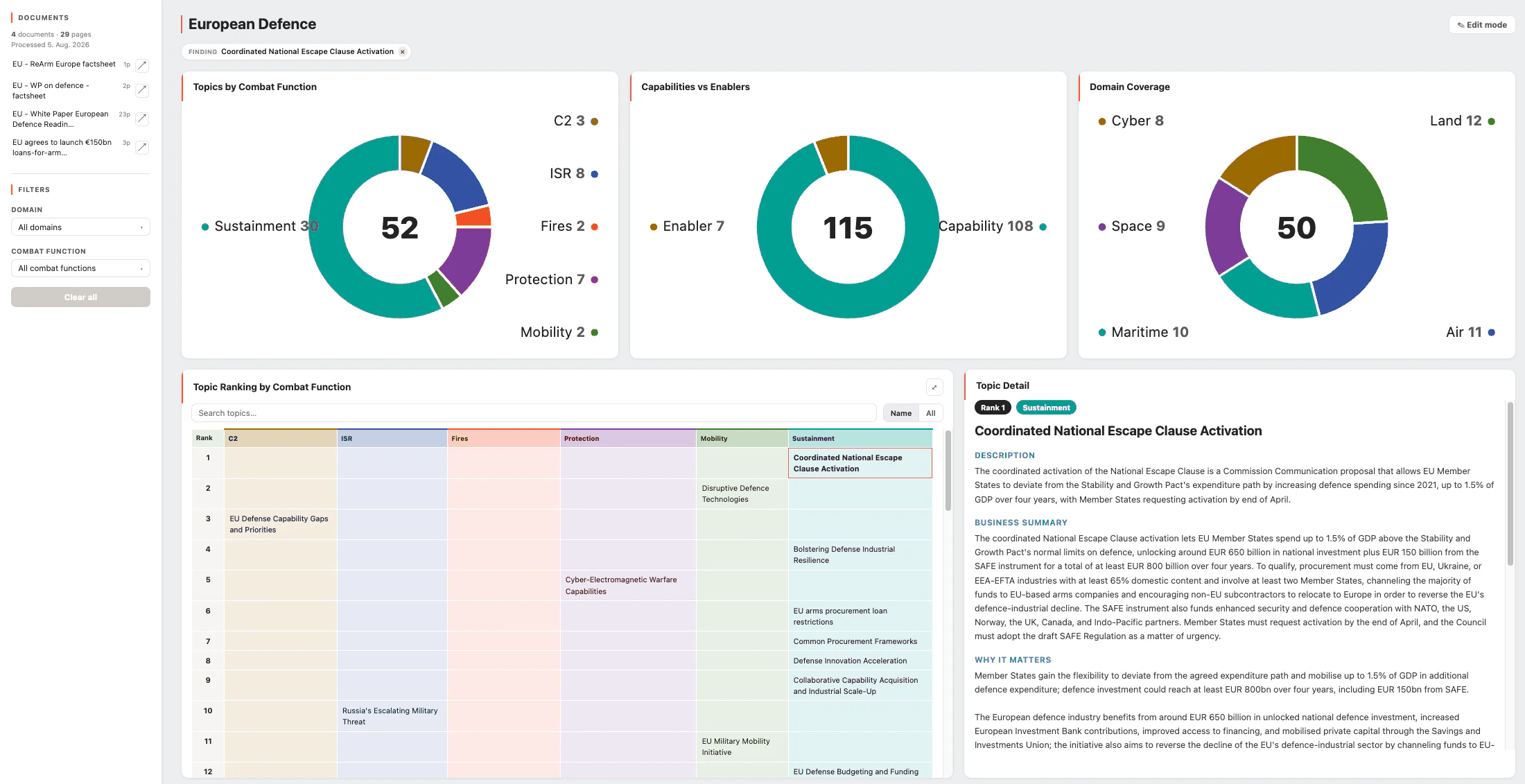
Where two documents land under the same combat function, with the passage carrying each shipped beside the other
Why one topic was ranked above another, with the grounds recorded during the run
Deliverables
What comes back, and on what clock?
Four deliverables come back, and four stages lead to them. The five working days begin when the released set arrives; before that the set is sized and quoted, and the quotation holds for 30 days.
Capability map
Six combat functions across the columns, three relevance tiers down the rows. The columns follow NATO Allied Joint Doctrine, and an empty cell means the set is silent, not that the capability is absent.
Capabilities and enablers separated
The capability the set argues for is held apart from the enabler it depends on, with the enablers your set attaches listed against it. A capability that recurs with no enabler attached is a finding in its own right.
Source traceability
Every entry carries the passage it came from, down to a character range in a named document. Topics are compared against each other rather than counted, and the grounds for each comparison ship with the result.
A complete summary, in one interactive document
One interactive and editable HTML document carries the findings and the source passages behind them in full. A disputed entry resolves to one sentence rather than to a bibliography, and nothing is installed.
How an engagement runs
Stage one
The enquiry
You describe the decision that has to be taken and roughly which documents could be released. No document changes hands.
Within two working days
The scoping reply
A written reply states what an analysis of that set could and could not establish.
At your speed
Sizing and custody
The set is sized in pages and quoted against four page bands. Custody is agreed in writing, and nothing is transferred until the quotation is accepted.
Within five working days
The capability map
The five working days start when the released set arrives. The summary, the capability map and the source passages come back in one interactive document.
One step
Send us the question, not the documents.
Describe the planning decision that has to be taken and roughly which documents could be released. A scoping reply comes within two working days, stating what an analysis of that set could and could not establish.