Our services
Defence consultancy: one method, three lines of sight.
The FORCE methodology does not change between engagements. What changes is the question you bring to the documents — and which silence in them turns out to matter.
Service lines
Three lines, one capability development methodology. Each reads a different kind of document set and brings a different question to it.
Force development
Armed Forces & Procurement
Capability profiles for force development and procurement decisions.
Learn more
Requirement analysis
Industry & Suppliers
Reading the requirement behind a tender.
Learn more
Policy evidence
Government & Administration
Evidenced foundations for security policy submissions.
Learn more
What an assessment delivers
Capability map
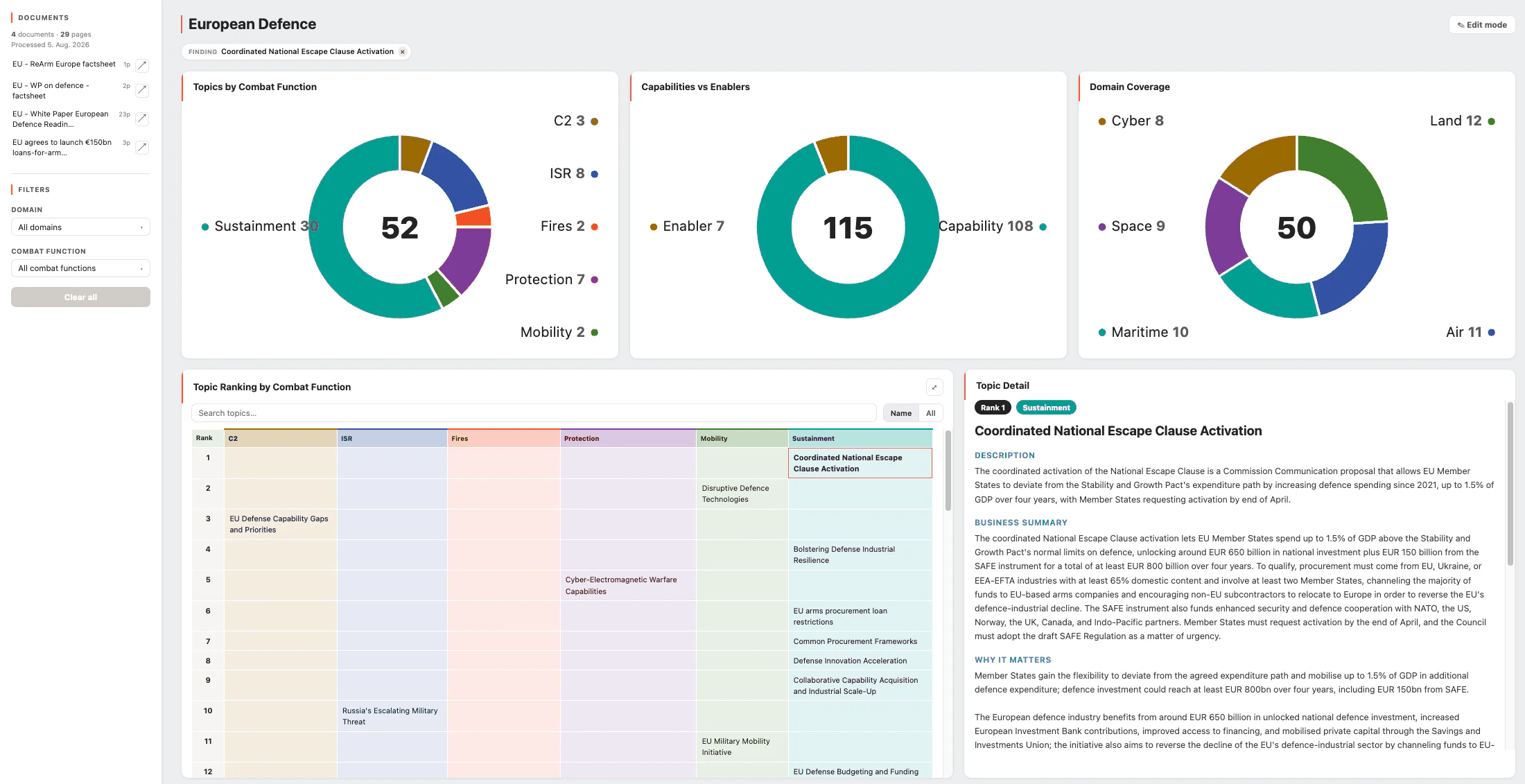
Six columns, three tiers. Every relevant passage in your set is assigned to a combat function and sorted into a tier, and capabilities stay distinct from the enablers they depend on. The columns are the NATO combat functions, which are not the same set as the US Army's warfighting functions. The map shows not only what the set argues for, but what that depends on and where the argument runs out.
Columns: command and control, fires, ISR, mobility and manoeuvrability, protection, sustainment
Rows: Priority, Notable, Mentioned
Every entry carries its reasoning and its source passage
An empty cell means the set is silent, not that a capability is absent
What an assessment delivers
Source traceability
Every finding resolves to a passage. Each extracted passage keeps an identifier, the document it came from, and its character range within that document, so a finding can be followed back to one sentence rather than to a bibliography, without asking anyone. The same three-step chain runs on a two-document set and on the 6,128-document register behind the Doctrine Explorer.
Input
Your documents
Doctrine, national strategies, studies, tenders, minutes, lessons-learned. PDF, DOCX or plain text; scanned pages fall back to optical character recognition.
Processing
Passage-level analysis
Relevant passages are extracted, de-duplicated, classified by combat function and labelled capability or enabler — each keeping its position in the source.
Result
Findings with provenance
Every finding lists the passage identifiers behind it, and the workbook ships those passages in full so a disputed finding can be checked directly.
What an assessment delivers
Relevance ranking
Topics are not ranked by how often they appear. They are compared against each other, and the grounds for each comparison are recorded and shipped with the result.
On larger sets an exhaustive comparison stops being practical, and the ranking switches to a tournament format that produces a comparable ordering without every possible pairing.
How the ranking is producedWhat you can check afterwards
Why one topic was ranked above another
Which passages carried each topic
Which tier a finding landed in, and on what grounds
Capability to enabler
The assessment lists, for each capability, the enablers your set connects to it. A capability that recurs with no enabler ever attached is a finding in its own right.
What an assessment delivers
Standpoint
The same document set reads differently depending on whose position you read it from. Secure long-range communication is a capability for one branch and an enabler for everyone who depends on it, and there is no neutral vantage point that settles the question.
Agreed before the run
The position the assessment is run from is fixed at the start, so labelling stays consistent across the whole set instead of drifting document by document.
Recorded with the result
The standpoint ships with the assessment. A disputed label becomes an argument about the position taken — which is productive — rather than about the method.
What an assessment delivers
What you get from FORCE
What you receive from a FORCE assessment.
Complete summary
A complete, comprehensible and clearly structured summary of the information from your source documents, delivered within five working days of the set being agreed.
Interactive HTML document
The results are provided in an interactive and editable HTML document.
Direct link to the source
The document contains both the analysis results and the underlying source information.
Capability map
Results are presented in a capability map: grouped by combat function in the columns and ordered by relevance in the rows. The six columns follow NATO Allied Joint Doctrine and stay fixed between engagements, which is what makes two assessments comparable.
Capabilities and enablers separated
FORCE consistently distinguishes between capabilities and the technologies required to deliver them (enablers).
Detailed reasoning
Every result element is explained with detailed reasoning, and each reason names the passage it rests on.
Transparent traceability
Every statement is transparent and traceable back to its original source.
Six properties that make an assessment usable
Specific
Analyses exactly the topics that are relevant to you.
Holistic
Unites different perspectives in a single analysis.
Uninfluenced
Uses exclusively your validated documents.
Extensive
Analyses large volumes of documents in a structured and efficient way.
Fast
Delivers results within five working days.
Current
Provides the right information at the right time.
Before you commission
How an analysis is commissioned
Four stages run from the first enquiry to the delivered map, and only the last two are on the clock: the five working days start when the released set arrives. An enquiry names the decision to be taken and roughly what could be released; the set is then sized in pages and quoted against four page bands, and nothing is transferred until that quotation is accepted.
Custody is agreed in writing before the set is handed over. The results belong to the commissioning organisation, are not passed on to other companies, and are not used for AI training. A quotation holds for 30 days.
Request an assessmentOne step
Send us the question, not the documents.
Describe the decision that has to be taken and roughly what you could release. Within two working days you get an assessment of what an analysis could and could not establish.